

Latest Terraform-Associate-004 exam dumps with real HashiCorp questions and answers
Terraform-Associate-004 Exam in First Attempt Guaranteed
HashiCorp Terraform-Associate-004 Exam Syllabus Topics:
| Topic | Details |
|---|---|
| Topic 1 |
|
| Topic 2 |
|
| Topic 3 |
|
| Topic 4 |
|
| Topic 5 |
|
NEW QUESTION # 53
Exhibit:
module " network " {
source = " terraform-google-modules/network/google "
version = " ~ > 11.0 "
}
What version of the source module does Terraform allow with the module block shown in the exhibit?
- A. Any version of the module > = 11.0 and < 12.0.
- B. Any version of the module > = 11.0.
- C. Any version of the module > = 11.0.0 and < 11.1.0.
- D. Any version of the module > 11.0.
Answer: A
Explanation:
Rationale for Correct Answer: The pessimistic constraint operator ~ > allows updates that do not change the leftmost specified digits beyond what's declared. With ~ > 11.0, Terraform allows any version that is > = 11.0 but < 12.0 (i.e., any 11.x release). This pins to the major version while allowing minor/patch updates.
Analysis of Incorrect Options (Distractors):
A: Incorrect-this excludes exactly 11.0 and doesn't express the upper bound that ~ > imposes.
B: Incorrect-missing the upper bound; ~ > always implies an upper limit.
D: Incorrect- > = 11.0.0 and < 11.1.0 corresponds to ~ > 11.0.0, not ~ > 11.0.
Key Concept: Module version constraints using the pessimistic (~ > ) operator.
Reference: Terraform Objectives - Interact with Terraform Modules (module versioning and registry usage).
NEW QUESTION # 54
Which of the following can you do with terraform plan?
Pick the two correct responses below.
- A. Schedule Terraform to run at a planned time in the future.
- B. Execute a plan in a different workspace.
- C. View the execution plan and check whether the changes match your expectations.
- D. Save a generated execution plan to apply later.
Answer: C,D
Explanation:
Detailed Explanation:
* Rationale for Correct Answer:
* A: terraform plan -out=planfile saves the proposed execution plan so you can later run terraform apply planfile. This supports review and controlled deployments.
* B: terraform plan shows what Terraform would change (create/update/destroy) so you can verify changes before applying-this is one of the primary purposes of plan.
* Analysis of Incorrect Options (Distractors):
* C: Incorrect. Scheduling runs is not a capability of terraform plan (that's handled by external schedulers/CI systems or HCP Terraform scheduling features-not the CLI plan command itself).
* D: Incorrect. Workspaces are selected via terraform workspace select < name > (or by using separate working directories / automation). terraform plan itself doesn't "execute in a different workspace" without switching context first.
* Key Concept: terraform plan for previewing changes and optionally saving an execution plan file for later application.
Reference: Understand Terraform Basics and CLI - terraform plan behavior, -out option, and plan/apply workflow.
NEW QUESTION # 55
Which argument can you set on a module block to prevent Terraform from updating the module's configuration during an init or get operation?
- A. source
- B. version
- C. count
- D. lifecycle
Answer: B
Explanation:
Rationale for Correct Answer: Setting the module version (for registry modules) pins the module release Terraform will use. By pinning the version, Terraform will not "update" the module to newer releases during terraform init -upgrade or terraform get -update unless you change the version constraint. This is the standard way to control module updates and keep module code stable across runs.
Analysis of Incorrect Options (Distractors):
B (lifecycle): lifecycle is for resources, not module blocks.
C (count): count controls how many module instances are created; it doesn't control module source updates.
D (source): source tells Terraform where the module comes from; it doesn't prevent updates by itself (a VCS
/ref pin would be done in the source string, but the module block argument that achieves this in the typical module workflow is version for registry modules).
Key Concept: Module version pinning to control module upgrades.
Reference: Terraform Objectives - Interact with Terraform Modules (module sources and versioning).
NEW QUESTION # 56
Your team adopts AWS CloudFormation as the standardized method for provisioning public cloud resources.
Which scenario presents a challenge for your team?
- A. Building a reusable code base that can deploy resources into any AWS region.
- B. Automating a manual, web console-based provisioning process.
- C. Managing a new application stack built on AWS-native services.
- D. Deploying new infrastructure into Microsoft Azure.
Answer: D
Explanation:
Rationale for Correct Answer: AWS CloudFormation is AWS-specific. If your standardized provisioning tool is CloudFormation, deploying infrastructure into Microsoft Azure becomes a challenge because CloudFormation does not natively provision Azure resources. This highlights a core IaC concept: tool
/platform scope and portability across clouds.
Analysis of Incorrect Options (Distractors):
A (Reusable code base for any AWS region): CloudFormation templates are commonly reusable across AWS regions; region differences are typically handled via parameters, mappings, and region-specific resource availability-not a fundamental challenge.
B (Managing a new stack on AWS-native services): This is CloudFormation's strength: managing AWS- native services with declarative templates and stack updates.
C (Automating manual console provisioning): Another core use case for IaC-CloudFormation is designed to replace manual provisioning with repeatable automation.
Key Concept: IaC tool scope and portability-AWS CloudFormation is tightly coupled to AWS, limiting multi-cloud provisioning.
Reference: Terraform Objectives - Understand Infrastructure as Code (IaC) Concepts (automation, repeatability, portability considerations) and Understand Terraform's Purpose and Use Cases (multi-cloud provisioning as a common Terraform use case).
NEW QUESTION # 57
terraform validate confirms thesyntaxof Terraform files.
- A. False
- B. True
Answer: B
Explanation:
terraform validatechecks for syntax errors and internal consistencyin the configuration files.
However, itdoes notcheck if resource configurations are valid with the provider.
Official Terraform Documentation Reference:
terraform validate - HashiCorp Documentation
NEW QUESTION # 58
The -refresh-only parameter will update your state file when used with terraform plan.
- A. False
- B. True
Answer: A
Explanation:
Rationale for Correct answer: terraform plan -refresh-only refreshes (reconciles) the state with the real infrastructure only for the purpose of the plan output. It does not persist (write) those updates to the state file. To actually update the stored state, you must run terraform apply -refresh-only (or a normal terraform apply). This matches the Terraform CLI objective: plan previews changes; apply makes changes (including writing state).
Analysis of Incorrect Options (Distractors):
A (True): Incorrect because terraform plan does not write state; it only calculates and displays what would change.
Key Concept: The plan vs apply workflow and when Terraform writes state.
NEW QUESTION # 59
Which command should you run to check if all code in a Terraform configuration that references multiple modules is properly formatted without making changes?
- A. terraform fmt -list -recursive
- B. terraform fmt -check
- C. terraform fmt -write-false
- D. terraform fmt -check -recursive
Answer: D
Explanation:
This command will check if all code in a Terraform configuration that references multiple modules is properly formatted without making changes, and will return a non-zero exit code if any files need formatting. The other commands will either make changes, list the files that need formatting, or not check the modules.
NEW QUESTION # 60
When using Terraform to deploy resources into Azure, which scenarios are true regarding state files? (Choose two.)
- A. Changing resources via the Azure Cloud Console does not update current state file
- B. Changing resources via the Azure Cloud Console records the change in the current state file
- C. When you change a Terraform-managed resource via the Azure Cloud Console, Terraform updates the state file to reflect the change during the next plan or apply
- D. When you change a resource via the Azure Cloud Console, Terraform records the changes in a new state file
Answer: A,C
Explanation:
Terraform state is a representation of the infrastructure that Terraform manages. Terraform uses state to track the current status of the resources it creates and to plan future changes. However, Terraform state is not aware of any changes made to the resources outside of Terraform, such as through the Azure Cloud Console, the Azure CLI, or the Azure API. Therefore, changing resources via the Azure Cloud Console does not update the current state file, and it may cause inconsistencies or conflicts with Terraform's desired configuration. To avoid this, it is recommended to manage resources exclusively through Terraform or to use the terraform import command to bring existing resources under Terraform's control.
When you change a Terraform-managed resource via the Azure Cloud Console, Terraform does not immediately update the state file to reflect the change. However, the next time you run terraform plan or terraform apply, Terraform will compare the state file with the actual state of the resources in Azure and detect any drifts or differences. Terraform will then update the state file to match the current state of the resources and show you the proposed changes in the execution plan. Depending on the configuration and the change, Terraform may try to undo the change, modify the resource further, or recreate the resource entirely. To avoid unexpected or destructive changes, it is recommended to review the execution plan carefully before applying it or to use the terraform refresh command to update the state file without applying any changes.
Reference = Purpose of Terraform State, Terraform State, Managing State, Importing Infrastructure, [Command: plan], [Command: apply], [Command: refresh]
NEW QUESTION # 61
Which of the following is not true of Terraform providers?
- A. HashiCorp maintains some providers
- B. Cloud providers and infrastructure vendors can write, maintain, or collaborate on Terraform
- C. An individual person can write a Terraform Provider
- D. providers
- E. A community of users can maintain a provider
- F. None of the above
Answer: F
Explanation:
All of the statements are true of Terraform providers. Terraform providers are plugins that enable Terraform to interact with various APIs and services1. Anyone can write a Terraform provider, either as an individual or as part of a community2. HashiCorp maintains some providers, such as the AWS, Azure, and Google Cloud providers3. Cloud providers and infrastructure vendors can also write, maintain, or collaborate on Terraform providers, such as the VMware, Oracle, and Alibaba Cloud providers. Reference =
* 1: Providers - Configuration Language | Terraform | HashiCorp Developer
* 2: Plugin Development - How Terraform Works With Plugins | Terraform | HashiCorp Developer
* 3: Terraform Registry
* : Terraform Registry
NEW QUESTION # 62
Terraform installs its providers during which phase?
- A. All of the above
- B. Refresh
- C. Plan
- D. Init
Answer: D
Explanation:
Terraforminstalls providers during the terraform init phase.
Providers aredownloaded and installedwhen running terraform init.
A (terraform plan)is incorrect because terraform plan only calculates changes but does not install providers.
C (terraform refresh)is incorrect because terraform refresh only updates the state but does not install providers.
Official Terraform Documentation Reference:
Provider Installation - HashiCorp Documentation
NEW QUESTION # 63
How does Terraform manage most dependencies between resources?
- A. By defining dependencies as modules and including them in a particular order
- B. The order that resources appear in Terraform configuration indicates dependencies
- C. Terraform will automatically manage most resource dependencies
- D. Using the depends_on parameter
Answer: C
Explanation:
This is how Terraform manages most dependencies between resources, by using the references between them in the configuration files. For example, if resource A depends on resource B, Terraform will create resource B first and then pass its attributes to resource A.
NEW QUESTION # 64
How would you reference the volume IDs associated with the ebs_block_device blocks in this configuration?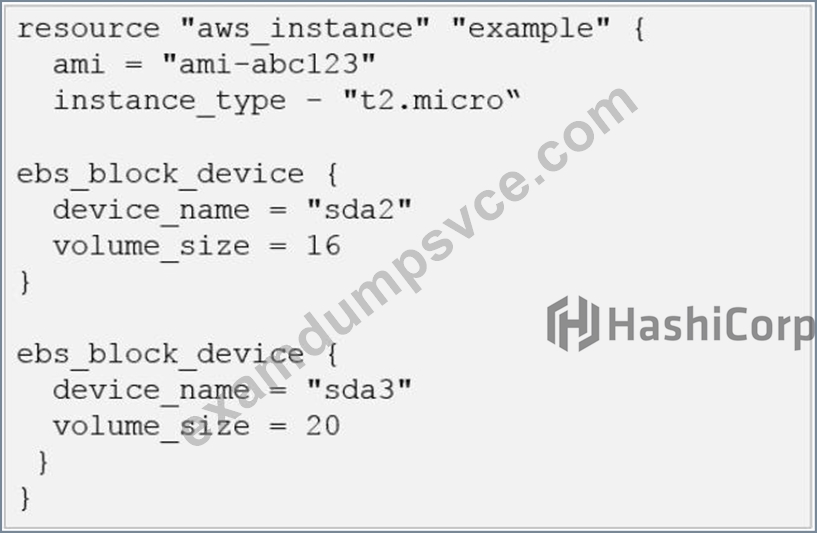
- A. aws_instance.example.ebs_block_device[sda2,sda3).volume_id
- B. aws_instance.example-ebs_block_device.*.volume_id
- C. aws_lnstance.example.ebs_block_device.[*].volume_id
- D. aws_lnstance.example.ebs_block_device.volume_ids
Answer: B
Explanation:
This is the correct way to reference the volume IDs associated with the ebs_block_device blocks in this configuration, using the splat expression syntax. The other options are either invalid or incomplete.
NEW QUESTION # 65
You can develop a custom provider to manage its resources using Terraform.
- A. False
- B. True
Answer: B
Explanation:
You can develop a custom provider to manage its resources using Terraform, as Terraform is an extensible tool that allows you to write your own plugins in Go language. You can also publish your custom provider to the Terraform Registry or use it privately.
NEW QUESTION # 66
You have developed a new cloud-based service that uses proprietary APIs and want to use Terraform to create, manage, and delete users from the service. How can Terraform interact with the service?
- A. Develop and publish a custom provider to interact with the service using its proprietary APIs.
- B. Terraform can manage users for any service that is hosted on a public cloud provider.
Answer: A
Explanation:
Rationale for Correct Answer (B):
Terraform interacts with external systems through providers. Since this is a new proprietary service with its own API, Terraform does not support it by default. You would need to develop a custom provider that implements Terraform's provider interface and interacts with the proprietary APIs to manage resources like users.
Analysis of Incorrect Option:
A . Any service hosted on a public cloud provider: Not true. Terraform can only manage services that have providers (official or custom). Just being "hosted on a public cloud" doesn't guarantee Terraform support.
Key Concept:
Terraform providers act as the bridge between Terraform and external APIs. For unsupported services, a custom provider must be developed.
Reference:
Terraform Exam Objective - Manage Terraform Resources and Providers.
NEW QUESTION # 67
Which of the following are advantages of using infrastructure as code (laC) instead of provisioning with a graphical user interface (GUI)? Choose two correct answers.
- A. Secures your credentials
- B. Prevents manual modifications to your resources
- C. Lets you version, reuse, and share infrastructure configuration
- D. Provisions the same resources at a lower cost
- E. Reduces risk of operator error
Answer: C,E
Explanation:
Infrastructure as code (IaC) is a way of managing and provisioning cloud infrastructure using programming techniques instead of manual processes1. IaC has many advantages over using a graphical user interface (GUI) for provisioning infrastructure, such as:
* Versioning: IaC allows you to store your infrastructure configuration in a version control system, such as Git, and track changes over time. This enables you to roll back to previous versions, compare differences, and collaborate with other developers2.
* Reusability: IaC allows you to create reusable modules and templates that can be applied to different environments, such as development, testing, and production. This reduces duplication, improves consistency, and speeds up deployment3.
* Sharing: IaC allows you to share your infrastructure configuration with other developers, teams, or organizations, and leverage existing code from open source repositories or registries. This fosters best practices, innovation, and standardization4.
* Risk reduction: IaC reduces the risk of human error, configuration drift, and security breaches that can occur when provisioning infrastructure manually or using a GUI. IaC also enables you to perform automated testing, validation, and compliance checks on your infrastructure before deploying it5.
Reference =
* 1: What is Infrastructure as Code? Explained for Beginners - freeCodeCamp.org
* 2: The benefits of Infrastructure as Code - Microsoft Community Hub
* 3: Infrastructure as Code : Best Practices, Benefits & Examples - Spacelift
* 4: 5 Benefits of Infrastructure as Code (IaC) for Modern Businesses in the Cloud
* 5: The 7 Biggest Benefits of Infrastructure as Code - DuploCloud
NEW QUESTION # 68
A developer launched a VM outside of the Terraform workflow and ended up with two servers with the same name. They are unsure which VM is managed with Terraform, but they do have a list of all active VM IDs. Which method could you use to determine which instance Terraform manages?
- A. Modify the Terraform configuration to add an import block for both of the virtual machines.
- B. Run a terraform apply -refresh to identify the virtual machine IDs that are already managed by Terraform.
- C. Run terraform state list to find the names of all VMs, then run terraform state show for each of them to find which VM ID Terraform manages.
- D. Run terraform state rm on both VMs, then terraform apply to recreate the correct one.
Answer: C
Explanation:
Rationale for Correct Answer (D):
terraform state list shows all resources currently managed by Terraform. terraform state show <resource> provides detailed attributes, including the VM ID. This lets you match the Terraform-managed instance with the actual infrastructure.
Analysis of Incorrect Options:
A: Importing is not needed since one VM is already in state.
B: terraform apply doesn't show which VM ID is managed, it only refreshes attributes.
C: Removing state entries is destructive and may lead to losing state data unnecessarily.
Key Concept:
The state file is Terraform's source of truth for which resources it manages.
Reference:
Terraform Exam Objective - Implement and Maintain State.
NEW QUESTION # 69
Your team adopts AWS CloudFormation as the standardized method for provisioning public cloud resources.
Which scenario presents a challenge for your team?
- A. Automating a manual, web console-based provisioning process.
- B. Building a reusable codebase that can deploy resources into any AWS region.
- C. Managing a new application stack built on AWS-native services.
- D. Deploying new infrastructure into Microsoft Azure.
Answer: D
Explanation:
Detailed Explanation:
* Rationale for Correct answer: AWS CloudFormation is a service specifically designed to provision and manage infrastructure within AWS only . It does not support multi-cloud environments such as Microsoft Azure. Therefore, attempting to deploy infrastructure into Azure using CloudFormation presents a clear limitation and challenge. This aligns with Terraform's core value proposition: multi- cloud and provider-agnostic infrastructure management , which overcomes this limitation.
* Analysis of Incorrect Options (Distractors):
* A. Building a reusable codebase that can deploy resources into any AWS region. Incorrect because CloudFormation supports reusable templates and can deploy across AWS regions without issue.
* B. Managing a new application stack built on AWS-native services. Incorrect because CloudFormation is purpose-built for AWS-native services and handles this scenario effectively.
* D. Automating a manual, web console-based provisioning process. Incorrect because CloudFormation is specifically designed to automate infrastructure provisioning, replacing manual console operations.
* Key Concept: Cloud-specific vs multi-cloud Infrastructure as Code tools - Terraform supports multiple providers, whereas CloudFormation is AWS-only.
Reference: Terraform Objective Domain: Understand Terraform ' s Purpose and Use Cases
NEW QUESTION # 70
You've enabled DEBUG-level logging for Terraform, and you'd like to send the log data to a file. Which action should you take?
- A. Add a path argument to the terraform block.
- B. Update the Terraform CLI configuration file.
- C. Set the TF_LOG_PATH environment variable.
- D. Run the terraform output command.
Answer: C
Explanation:
Rationale for Correct answer: Terraform logging is controlled via environment variables. TF_LOG sets the verbosity (e.g., DEBUG), and TF_LOG_PATH directs Terraform to write those logs to a specified file path. This is part of Terraform CLI troubleshooting and operational usage.
Analysis of Incorrect Options (Distractors):
B (Update the Terraform CLI configuration file): The CLI config can control some behaviors (credentials helpers, plugin cache, etc.), but log-to-file is specifically handled by TF_LOG_PATH.
C (Add a path argument to the terraform block): The terraform block configures required versions, required providers, and backends-not CLI logging output.
D (Run the terraform output command): terraform output displays output values from state; it has nothing to do with logging.
Key Concept: Terraform debugging and logging via environment variables (TF_LOG, TF_LOG_PATH).
NEW QUESTION # 71
......
Exam Sure Pass HashiCorp Certification with Terraform-Associate-004 exam questions: https://lead2pass.examdumpsvce.com/Terraform-Associate-004-valid-exam-dumps.html
